
Agile Methodology for Website Development: Principles, Types, Benefits & Best Practices
-
 Last Updated On
Are you starting a new project that requires a website? Are you trying to get a website built, but finding that development stages keep falling behind schedule? Requirements change, new features are added, and stakeholder feedback arrives after development is already underway. Developers have to revisit completed work, deadlines start slipping, and the final product may not fully meet user expectations.
How can you build a website that adapts to change while keeping development on track? Agile methodology offers an answer. By breaking development into smaller sprints and encouraging continuous collaboration, testing, and feedback, Agile helps teams build and improve websites throughout the development process.
Most white-label web development companies use Agile methodology to streamline workflows, improve client satisfaction, and deliver better results. In this blog, we’ll walk you through Agile methodology for website development, its key principles, types, benefits, and best practices for adapting quickly and collaborating effectively.
Agile web development is an iterative approach to building websites that emphasizes flexibility, collaboration, and iterative improvement. In traditional “waterfall” methods, projects follow a rigid, linear path.
Agile methodology, by contrast, breaks work into smaller cycles called sprints, typically lasting 1-4 weeks. Each sprint delivers a functional increment of the website, allowing teams to gather early feedback and adapt quickly.
Key principles of Agile web development include:
For web projects, this means faster time to market, reduced risk, and higher-quality outcomes.
Agile web development follows principles that help teams stay flexible, collaborate effectively, and deliver valuable website features faster. These principles focus on customer needs, continuous delivery, adaptability, technical quality, and ongoing improvement.
Agile prioritizes customer satisfaction by delivering valuable website features early. This allows clients to review working functionality and provide feedback throughout development.
Agile teams remain flexible when requirements change during development. Agile teams can incorporate new business needs, user feedback, or market changes into upcoming iterations.
Instead of waiting until the entire website is complete, Agile teams deliver functional features in short, regular iterations. This makes testing and feedback easier.
Agile encourages regular communication between business stakeholders, designers, developers, and testers. This keeps technical decisions aligned with business objectives.
Agile projects rely on skilled and motivated team members who take ownership of their responsibilities. Teams perform better with the right support and autonomy.
Direct communication helps teams resolve questions and misunderstandings quickly. Daily 15-minute stand-ups (in-person or async) are essential for agile software development with distributed teams, keeping everyone aligned on progress, goals, and blockers.
Agile measures progress through functional website features rather than documents or completed meetings. Working software provides clearer evidence of actual development progress.
Agile teams aim for a consistent development pace instead of relying on excessive overtime. A sustainable workload helps maintain quality and reduce developer burnout.
Agile emphasizes clean code, testing, security, performance, and reliable architecture throughout development. Addressing technical issues early helps reduce technical debt.
Agile teams focus on building only what is necessary to meet current user and business requirements. Avoiding unnecessary features reduces development time and technical complexity.
Agile gives teams more responsibility for deciding how to complete their work. Developers, designers, and testers can organize tasks based on project requirements.
Agile teams regularly review their processes to identify what worked and what needs improvement. These retrospectives help refine workflows, communication, and development practices.
Agile is a mindset; although it shares the same core principles, it is not a one-size-fits-all process. Different types suit different project needs, team sizes, and workflows. Each type has its own characteristics, making it a good option for different team sizes, objectives, or industries.
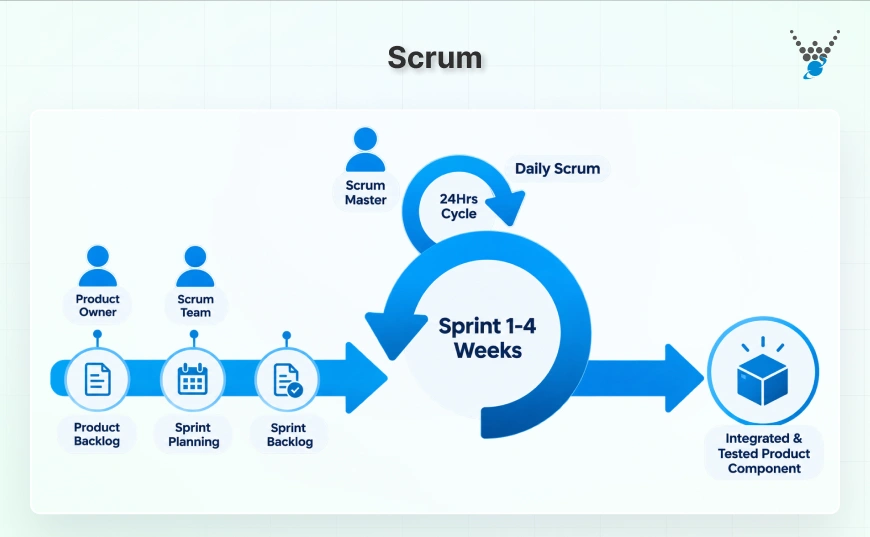
Scrum is an extensively used Agile framework for managing complex projects, especially in web development. It breaks the web development process into short cycles called sprints with defined roles (Scrum Master, Product Owner, Developers).
At the end of each sprint, the team evaluates the results and plans the next steps. A prioritized backlog guides tasks, ensuring the team focuses on high-value features first. Scrum promotes collaboration, continuous feedback, and project improvement. Ken Schwaber and Jeff Sutherland developed this framework in the early 1990s.
For Example:
A SaaS startup uses Scrum to roll out new dashboard features every two weeks based on user feedback.
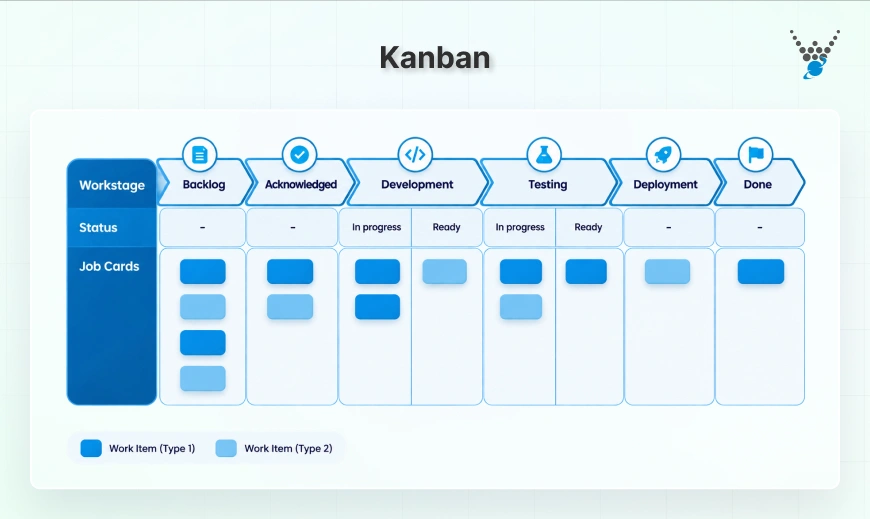
Kanban is a well-known Agile software development framework. This approach helps organizations manage evolutionary and incremental change. Unlike Scrum, it has no sprints; tasks move continuously as capacity allows. Perfect for ongoing maintenance or unpredictable workloads, Kanban promotes efficiency by exposing bottlenecks.
Kanban visualizes workflow using a board (To Do, In Progress, Done) with strict work-in-progress (WIP) limits. Remove this sentence or update to: “Modern project management tools like Jira, Trello, Asana, and Monday.com offer digital Kanban boards.
Teams improve flow by analyzing cycle times. That makes it great for agencies handling multiple client projects simultaneously.
For Example:
A marketing team uses Kanban to manage continuous website tweaks without disrupting major releases.
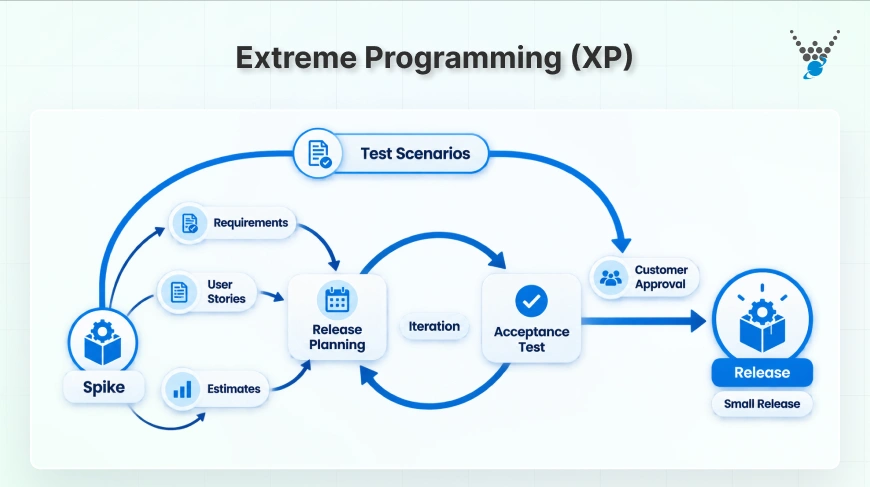
Extreme Programming (XP) is an agile software development framework that claims to build a higher-quality product. XP emphasizes technical excellence with practices like pair programming, test-driven development (TDD), and frequent releases. It builds close relationships among developers, testers, and consumers.
XP focuses on improving software quality while consistently adapting to evolving requirements throughout the project. Developers write tests before writing code to ensure robustness, while continuous integration catches errors early.
Extreme Programming is best for complex, rapidly changing projects. Its focus on code quality reduces long-term bugs, even if it requires higher initial effort.
For Example:
A fintech firm uses XP to ensure bug-free transaction processing with hourly code reviews.
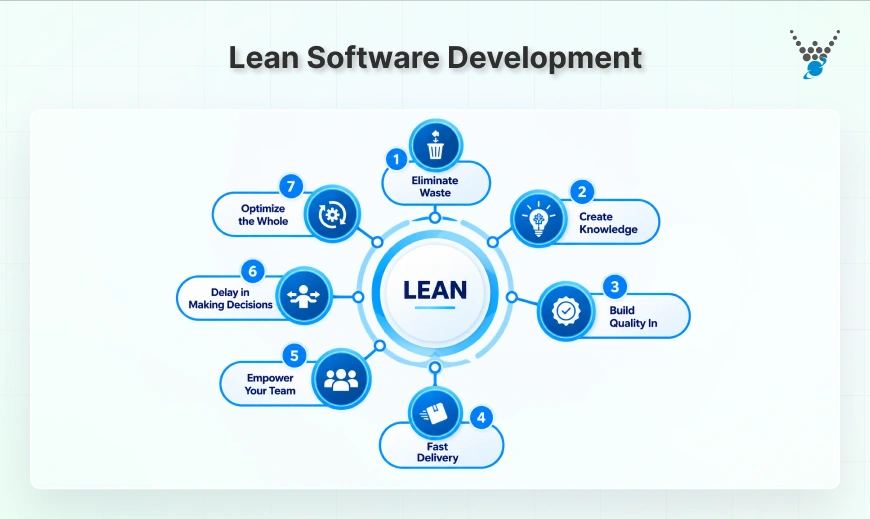
Lean software development is an approach that originated from lean manufacturing principles to enhance efficiency and reduce waste in the software development process. Lean principles often inform MVP strategies, as both emphasize eliminating waste and delivering core value quickly. However, Lean is a comprehensive methodology while MVP is a product development strategy.
The lean methodology is based on 3 principles: eliminating waste, improving workflows, and increasing customer value. This approach examines each action to identify tasks that don’t add value. To deliver software on time, the approach reduces cycle time and responds quickly to feedback and changing requirements.
Implementing LSD requires an initial investment in training, tools, and process redesign.
For Example:
An ecommerce team uses Lean software development to launch essential checkout features first, eliminate unnecessary development work, and add features based on customer feedback.
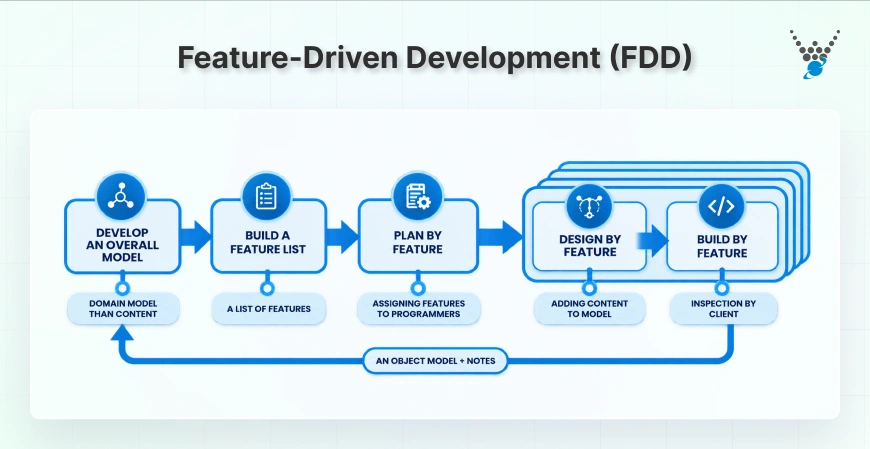
FDD organizes work around client-valued features, delivered in 2-week increments. A chief architect defines the system, then teams build features via five-step workflows (model, list, plan, design, build). Jeff De Luca first implemented FDD in 1997 on a large-scale banking software project in Singapore.
Best for large-scale projects, FDD balances agility with clear milestones to ensure consistent progress.
FDD aims to provide timely updates and working software to the consumer.
For Example:
An enterprise builds a CMS by shipping one feature module (e.g., image editor) at a time.
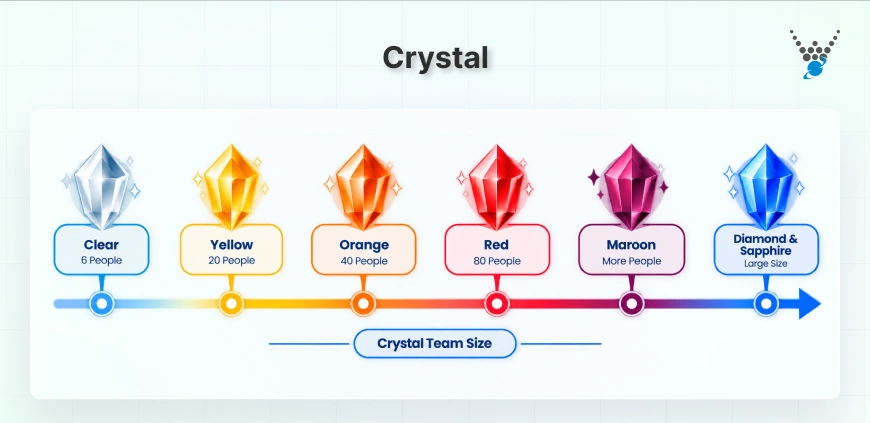
Crystal is a lightweight, human-centered agile development framework created by Alistair Cockburn at IBM in 1991 that prioritizes people and their interactions over rigid processes and rules. The approach focuses on team skills, communication, and collaboration as the primary drivers of success. It also recognizes that every project is unique, allowing teams to tailor their practices to size and complexity.
Since the approach focuses on individuals and their interactions, the methods are color-coded by the level of risk to human life. It is mainly for short-term projects by a team of developers working out of a single workspace.
For Example:
A small website team uses the Crystal methodology to communicate closely, make quick decisions, and adapt development based on regular user feedback.
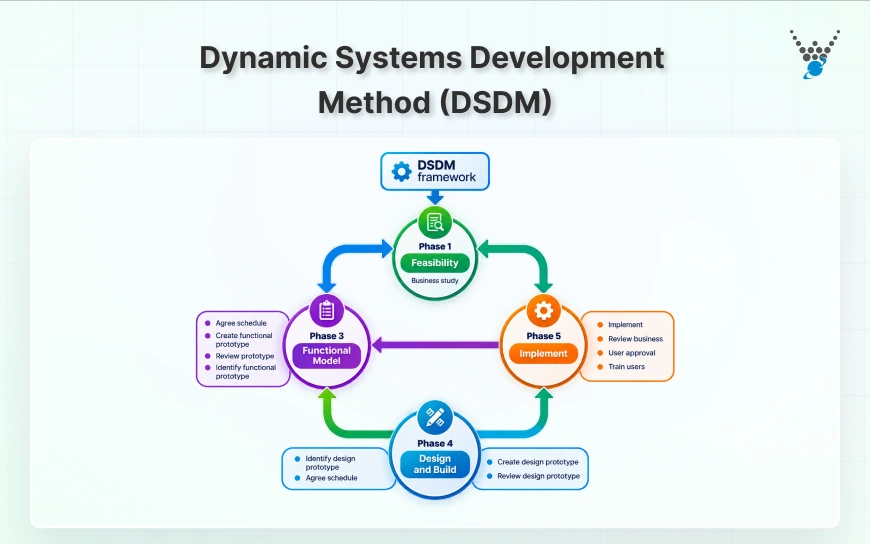
The Dynamic Systems Development Method was created in 1994 to add strong governance, structure, and discipline to Rapid Application Development (RAD). Unlike other Agile methods that flex time and resources to fit changing features, DSDM fixes time, cost, and quality at the start and adjusts scope to meet those limits.
DSDM combines Agile flexibility with governance, using a feasibility study, iterative development, and strict timeboxing. Requirements are prioritized using the MoSCoW method: ‘Must Have’, ‘Should Have’, ‘Could Have’, and ‘Won’t Have (this time)’.
Ideal for regulated industries (e.g., finance), DSDM ensures compliance without sacrificing speed.
For Example:
A healthcare portal launches a secure patient portal first, deferring “nice-to-have” analytics. The best methodology depends on your team’s pace, project complexity, and how much change you expect.
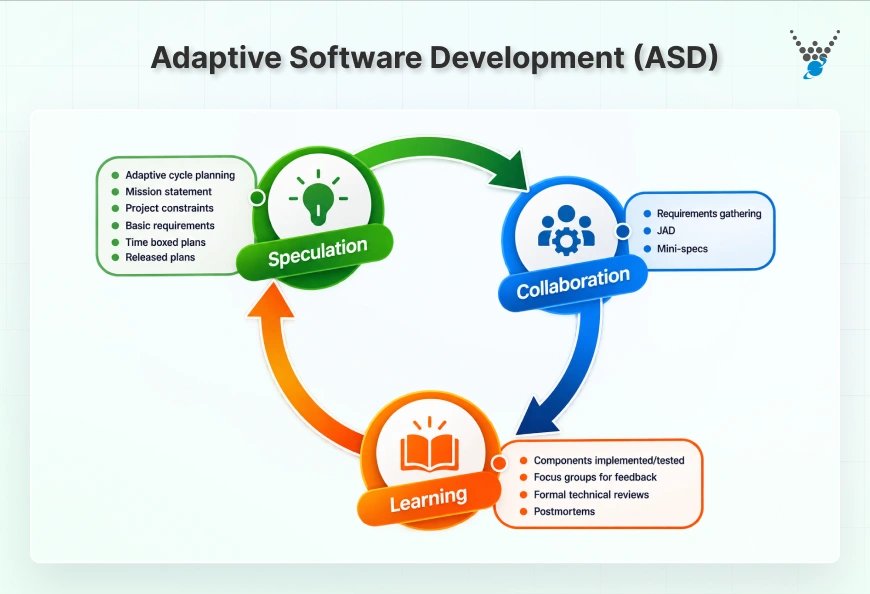
ASD focuses on learning over planning, with cycles of speculate (plan), collaborate (execute), and learn (review). Teams embrace change and use rapid prototyping to validate ideas. Perfect for innovative web apps, ASD’s iterative feedback loops reduce risk by testing assumptions early.
It emphasizes adaptability to respond to changing requirements and environments. ASD aims to achieve customer satisfaction by delivering products that meet their expectations.
For Example:
A travel app tests a new booking UI, scraps it after low engagement, and pivots within a month.
When you work on a website project, the development methodology you choose can make or break its success. The two dominant approaches are Agile and Waterfall. They differ in workflows, risks, and deliverables.
Let’s take a deep dive into the comparison through the table given below.
| Factor | Agile Methodology | Waterfall Methodology |
|---|---|---|
| Approach | Iterative and incremental (sprints/cycles) | Linear and sequential (phases) |
| Flexibility | High (adapts to changes mid-project) | Low (changes require restarting phases) |
| Project Phases | Overlapping (design, dev, test happen concurrently) | Strictly separated (complete one phase before next) |
| Client Involvement | Continuous (feedback loops at each iteration) | Limited (mostly at requirements & delivery stages) |
| Delivery Timeline | Frequent releases (working features in sprints) | Single delivery at project end |
| Risk Management | Early issue detection (fail fast, fix fast) | Risks surface late (harder/expensive to fix) |
| Documentation | Lightweight (focus on working software) | Extensive (detailed specs upfront) |
| Best for | Dynamic projects (evolving requirements, startups, MVPs) | Predictable projects (fixed scope, strict compliance) |
| Team Structure | Cross-functional and collaborative | Role-based and hierarchical |
| Cost Control | Variable (scope adjusts to budget/time) | Fixed (budget/timeline set early) |
Agile methodology for websites offers several benefits that simplify the web development process.
The best way to embrace Agile web development is to start small, break the process into short, manageable sprints, and maintain continuous communication with users and the team.
Let’s understand the best practices for adopting Agile web development:
Implementing Agile in web development requires more than dividing work into sprints. Teams need a clear project goal, a cross-functional team, a prioritized backlog, regular communication, and continuous feedback. The process typically moves through short development cycles in which teams plan, build, test, review, and improve features before the next iteration.
Key steps include:
Agile methodology isn’t just a process; its benefits in web development show it can support a more efficient, seamless workflow. It’s a flexible, collaborative, and results-driven process. Agile approaches larger projects by breaking them into smaller sprints. It encourages collaboration across project teams while keeping stakeholders involved.
Developers can build the final product to meet consumer needs through flexibility and continuous improvement. This approach uses iterative sprints, embraces feedback, and prioritizes working software over rigid plans.
To make the most of Agile methodology for websites, you need an experienced team that can adapt quickly, collaborate effectively, and deliver quality results through every sprint. Hire our dedicated web development professionals today!
Agile development is an iterative, flexible approach that builds websites in small, continuous cycles. In contrast, traditional web development (Often called Waterfall) is a linear, sequential process with rigid phases planned completely upfront.
A sprint usually lasts one calendar month or less, with two weeks as the most common industry standard, depending on project complexity. Shorter sprints work best for fast-paced web projects.
When requirements change mid-sprint, the team evaluates the impact. If changes are minor, they try to protect the sprint goal while incorporating them. If updates are major, they defer them to the next sprint to avoid disruption.
Avoid Agile methodology when the project has strict, unchanging requirements, a fixed budget, and heavy regulatory constraints that demand complete upfront planning.