
Digital Marketing KPIs: Ways to Track the Campaign Effectiveness
-
 Last Updated On
Starting a digital marketing campaign without any measurable goals won’t do any good. You need to continuously evaluate the results against some key performance indicators to see if it’s working as intended. Then you can optimize the campaign for the best results.
Digital marketing KPIs offer you strategic insights into the campaign. They help you move beyond tracking clicks to understand if your efforts are delivering any actual value. It enables well-informed performance evaluation, budget allocation, and continuous optimization.
This blog explains the digital marketing KPIs, how to track them, and the best practices to follow. Let’s look at them one by one.
Digital marketing KPIs provide quantitative insights into the effectiveness of your marketing efforts. These metrics show whether you are succeeding or not and how you can improve your results. You can categorize these KPIs into different stages of the customer journey: Awareness, Consideration, Action, and Loyalty.
For instance, if you are running Google Ads, the KPIs will depend on your goal: leads, sales, or awareness. Based on that, you need to track metrics like Return on Ad Spend (ROAS), Click-Through Rate (CTR), Conversion Rate, and Cost Per Acquisition (CPA). They measure profitability, relevance, and effectiveness.
KPIs in digital marketing turn vague goals into measurable targets. With these, you can track performance and ROI to make data-driven decisions that optimize your campaigns. Let’s look at a few reasons to carefully choose and track key performance indicators.
Without these metrics, you will be investing in digital marketing blindly. They give you a way to justify the investments in both time and money. You can eliminate the weak parts of the campaign and promote the profitable ones.
Several KPIs are tied to SMART (Specific, Measurable, Achievable, Relevant, Time-bound) goals in digital marketing. We’ll start with KPIs available in analytics tools that don’t need to be calculated.
Website traffic is the total number of visitors that access your website. It’s a direct indication of how well the search engine optimization (and PPC) is performing. The higher the traffic, the more people are interested in your brand and offerings.
Analyzing traffic in detail reveals where visitors are coming from. They come from organic search engines like Google and Bing, direct visits from other websites, or even paid ads.
One of the best platforms to monitor paid and organic website traffic is Google Analytics 4. Its interactive graphs display traffic trends both locally and globally over a specific period. Additionally, you can see the number of active users on the website at any given time.
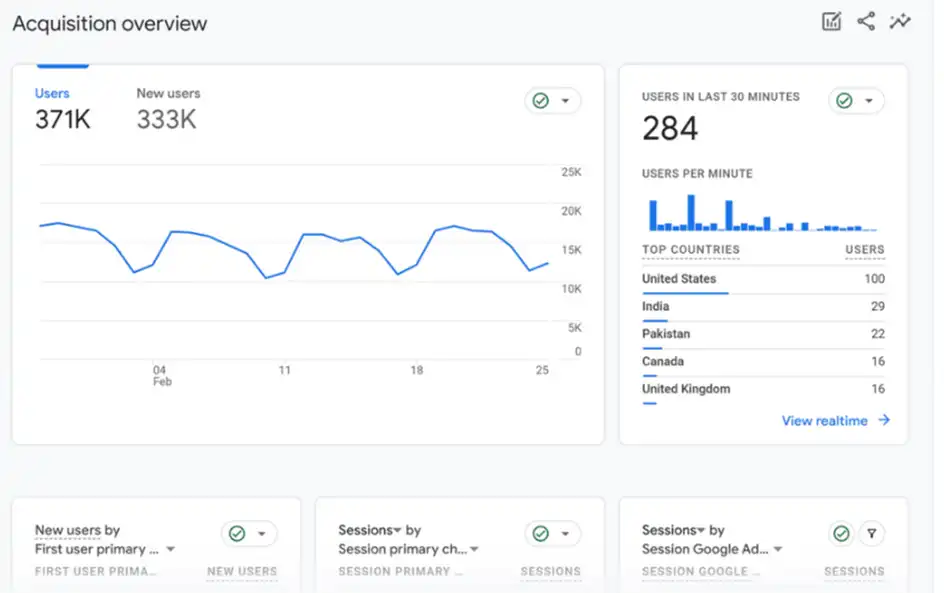
This KPI is roughly similar to website traffic. Impressions show how often a page, link, or ad is shown to the users and Clicks show how many users clicked on them. Monitoring these two metrics gives you an idea of optimizing the pages to improve their performance.
Impressions indicate visibility of your page or site, while clicks show engagement on it. So by design, impressions will be higher than the clicks.
CTR, i.e. the Click-Through Rate, is the percentage of users clicks on a link or ad out of those who have seen it.
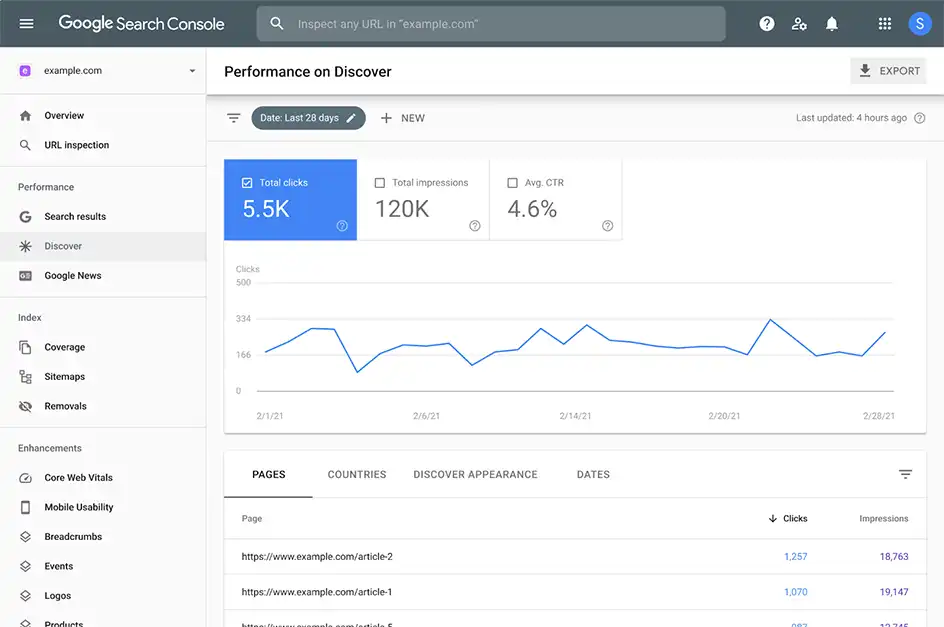
Most professional SEO services use Google Search Console to check the clicks and impressions. Not only does it show the total metrics for a website, but it also shows the metrics for each page.
Keyword rankings measure where your site or page appears in organic search engine results for specific terms. Higher rankings for relevant keywords indicate that your pages are well-optimized; they will receive higher impressions from organic traffic.
To improve your rankings, you will need to use relevant keywords, include backlinks from reliable sites, and, of course, create quality content.
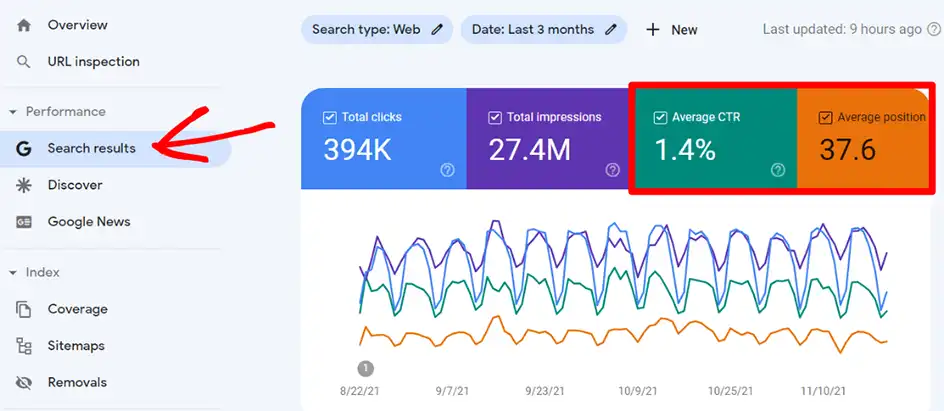
A few of the best platforms for checking the keyword rankings include Google Search Console, Semrush, and Ahrefs.
Domain authority shows how well a website performs on a scale of 1-100. The higher the score, the higher a website ranks on the SERPs, compared to its competitors. While it’s not a direct ranking factor, DA is still an excellent measure of the quality of a website’s search performance.
This digital marketing KPI compares your site against other similar ones, giving an idea about its standing in the market. If a website has a higher DA score, it likely has strong inbound backlinks and a proper SEO strategy (on-page and off-page). (You can do a backlink check on your website to understand how to strategize further.)
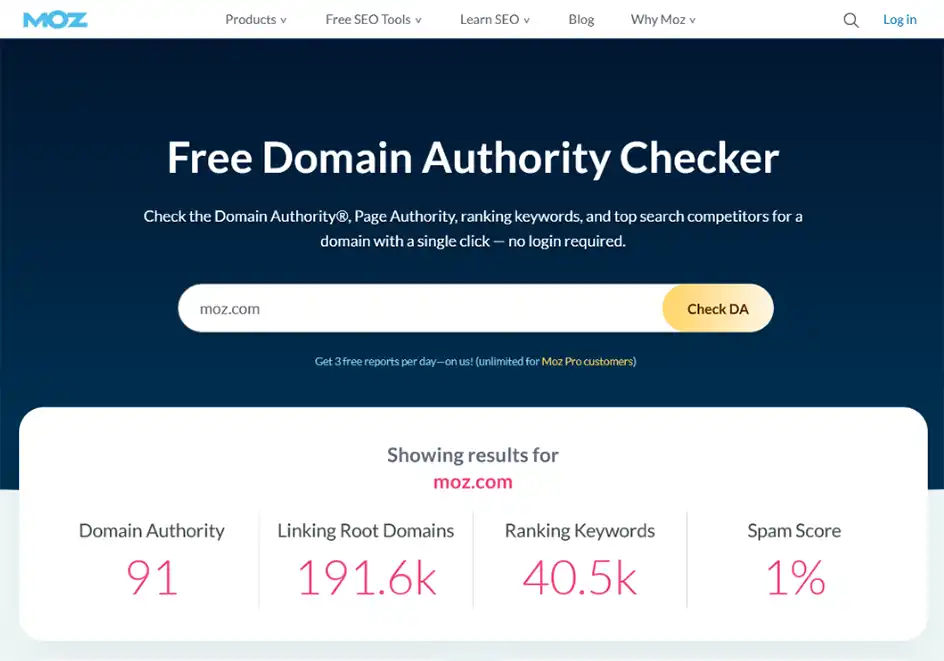
Two of the best tools for checking authority are Moz and Ahrefs. They use ML algorithms to judge the likelihood of your site domain appearing in the Google SERPs.
Social media engagement metrics are the most obvious signs of how successful a social media post is. Likes show the post resonated with the user, and comments show it resonated with them. And shares mean users are willing to endorse and promote your content to new audiences.
Platforms like Instagram, Twitter, TikTok, etc. use these metrics to work out the content quality. The algorithm is more likely to promote posts with good likes, shares, and comments.
Conversion rate is a percentage metric of how many users completed a desired action, like making a purchase, clicking an ad, signing up for a subscription, etc. It’s a direct metric of the effectiveness of a marketing campaign, user flow, website design, and more.
To improve the conversion rate, you can use A/B testing to compare different versions of site design or marketing copy. Assess which one delivers the best conversions and implement it throughout.
Conversion Rate = (Conversions / Total Visitors) * 100%
Let’s say 200 people visited your e-commerce website, but only 20 of them made a purchase. That means a conversion rate of 10%.
Customer Acquisition Cost is the total investment required to acquire a customer. That means costs associated with marketing, sales, tools, salaries, and other overheads to convert a lead into a paying customer.
CAC lets you determine if a particular customer or source is worth investing in. You can also identify the most growth-focused, cost-effective channels and invest in them strategically. This metric helps you understand that retaining existing customers is far more cost-effective than acquiring new ones.
Customer Acquisition Cost = Total Investment in Marketing, Sales & Overheads / Number of New Customers
If you invest $6000 in marketing, sales, and overheads to acquire 100 new customers, the cost per customer acquisition is $60.
Customer Lifetime Value is the estimated revenue a business expects to earn from a single customer throughout their transactional relationship. Rather than just sales and revenue, the focus on this marketing KPI is on long-term retention and loyalty.
For the best CLV, you must consider the average order value, purchase frequency, and customer lifespan. Additionally, the website needs to provide an excellent customer experience to encourage repeat purchases beyond the first transaction.
Customer Lifetime Value = Average Customer Transactional Lifespan (in years) * Number of Purchases in a Year * Average Order Value
For instance, a customer has been active on a platform for 5 years and made 4 purchases per year with an average AOV of $40. Then the Customer Lifetime Value is $800.
Click-through rate is the percentage of people who clicked on a page link or ad (clicks) out of the people who saw it.
CTR is the most commonly evaluated digital marketing metric to determine the campaign’s effectiveness. It shows how good your content or ad copy was at garnering engagement. Based on the CTR, marketing professionals optimize their emails, ad copies, and SEO strategies.
Click-Through Rate = (Number of Clicks / Number of Impressions) * 100%
Let’s say your PPC ad got 2000 impressions but only 100 clicks. That means a CTR of 5%, which means either it didn’t reach the target audience or they didn’t find it relevant enough. Either way, optimization is needed.
Cost Per Click is a KPI that measures the average cost incurred to acquire a single click through the campaign. It gives an idea on whether the strategy is cost-efficient or not.
When setting up a PPC campaign, you first set a maximum CPC bid, which is the max you are willing to pay per click. But then, thanks to the algorithm, you end up paying a lesser Actual CPC. Then the ad quality and CPC bid determines where your ad will be placed on the SERPs.
Then you pay only when there’s a click on your ad or link. Higher CPC combined with a quality ad copy is a driving factor for higher sales (money or sign-ups) and revenue.
To improve the CPC, you need to improve the quality score of your ad copy, use negative keywords to filter out irrelevant queries, and refine the target audience.
CPC = Total Ad Spend / Total Number of Clicks
For e.g. if your total ad spend was $500 and you got 2000 clicks through your campaign, the final CPC is $0.25.
Bounce Rate is the percentage of site visitors who leave a website after viewing just one page. A direct metric of how engaging your website and page is. It shows the page isn’t engaging enough.
The higher the bounce rate, the worse the user experience and content quality. You can lower bounce rates by improving the website design and layout. You can also boost the load speed and performance. Finally, make the content more relevant.
Bounce Rate = (Number of single-page visits / Total number of site visits) * 100%
For instance, if 1000 people visited your site and 400 of them left immediately, the bounce rate is 40%. You can analyze the site visits through top tools like Google Analytics, Hotjar, Optimizely, etc.
Return on Ad Spend is an important digital marketing KPI. It measures the total revenue made for each dollar spent on the marketing campaign. Evaluating ROAS gives you an idea of campaign effectiveness, profitability, and future budget allocation.
A higher Return on Ad Spend means higher revenue, but you also need to track other metrics, such as Cost Per Acquisition, for a complete financial assessment.
Return on Ad Spend = Total Revenue from Ads / Cost of Ads
If you spend $300 on your PPC and social media ad campaign and generate $1,500 in total revenue, the ROAS is 5:1. This means you earn $5 for every $1 spent.
Customer Retention Rate evaluates the percentage of customers a business retains over a period of time. A higher CRR indicates that your business values loyalty and ongoing engagement. It reduces customer acquisition costs and boosts long-term profits.
This metric is important because retaining customers is more profitable than acquiring new ones. Retained customers spend more time on the site and often provide feedback to new customers.
Customer Retention Rate = [(Total Number of Customers at the End – Number of New Customer Acquisitions) / Total Number of Customers at the Start] * 100%
Let’s say you started with 100 customers at the start of Q1 and acquired 20 new customers. But you ended Q1 with 110 customers at the end. That means a Customer Retention Rate of 90%.
Several other digital marketing KPIs are integral to the success of a campaign. You need to choose the most effective ones.
While there are many KPIs available for evaluating a digital marketing campaign, not every one of them will be suitable for yours. You should choose the right ones based on your business goals, marketing channels, budget, and more.
What is your goal with the marketing strategy? Do you want more leads, higher traffic, higher revenue, or more brand awareness? Map them according to the marketing funnel:
Link your KPIs directly to revenue-driving objectives and focus on actionable data. This is what makes a digital marketing strategy successful.
Marketing metrics are more than just numbers. They help us see how a campaign is doing and how to make it better. With dashboards like Google Analytics, you can evaluate KPIs like traffic, impressions, clicks, keyword rankings, and other advanced ones. With this data, you can move from mere activity to significant impact.
Digital marketing KPIs have to be evaluated regularly to make sure the strategies are working as intended, towards your business objectives.
If you want assistance with your campaign and its optimization, get help from our experts today!
According to this rule, 70% of resources are allocated to core strategies (like SEO, content marketing, etc.). Then 20% of resources go to growth-focused content like webinars and case studies, and 10% to experimental ideas like viral trends and latest platforms.
The 7 Ps of digital marketing are Product, Place, People, Physical Evidence, Price, Promotion, and Process. It helps create a holistic marketing campaign.