
SEO Vs GEO: Key Differences and Guide for Optimization
-
 Last Updated On
A large number of users are turning to AI tools for their queries. That’s why generative engine optimization (GEO) is a highly discussed topic right now. However, this does not mean search engine optimization (SEO) is dead. You need to optimize your site for both because they serve different purposes.
In this guide, we will discuss the differences between SEO and GEO, so you can better modify your strategies. We will also cover important trends to consider and best practices for making SEO and GEO work together. So, let’s begin!
SEO involves optimizing your website to rank higher in search results for queries related to your niche. Essentially, it is a bridge that connects users with your website.
There are two main goals of SEO. The first is to bring relevant traffic to the website. The second is to improve its overall search visibility. You can optimize your website for SEO by publishing high-quality content, getting backlinks from credible sources, and structuring the site’s user experience.
GEO optimizes your website for AI-powered search engines like ChatGPT, Gemini, Perplexity, and others.
The main goal of GEO is to get your website mentioned in generative AI tools for queries related to your niche and industry. You can improve your website for GEO by organizing information. Use structured data markup and share accurate facts. Also, include multimedia.
People can consider GEO an extension of SEO for LLMs (Large Language Models). So, it’s also called LLM SEO.
SEO and GEO differ an seo services company improves visibility. SEO targets regular search engines like Google and Bing. GEO, however, focuses on popular AI models from OpenAI, Google, Meta, Microsoft, and Anthropic.
SEO and GEO are complementary, not competitive. Therefore, it is important to understand both and what differentiates them. Here are some key points where they differ from each other:
Both SEO and GEO differ mainly in the search results they produce. Search engines interpret users’ queries and offer multiple content resources. It is then up to you to choose the most relevant content piece.
For example, if the user wants to explore Las Vegas. To search for that the user will enter “top places to visit in Las Vegas” on Google. A screenshot is attached below for representation.
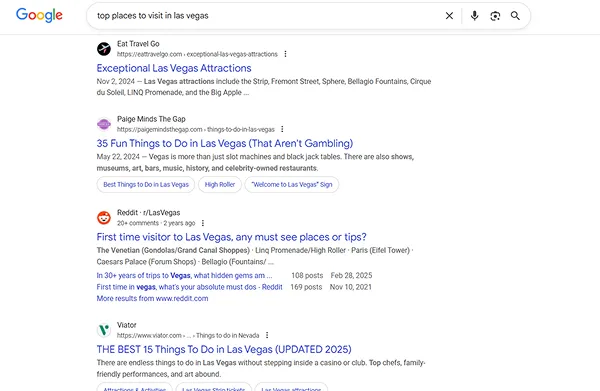
As you can see, Google offers various articles to help with your trip. Now, the same user query will be passed to ChatGPT:
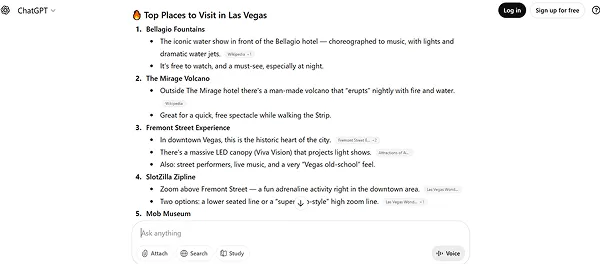
Here, ChatGPT has provided a summary of information from various sources, such as blog posts, videos, and user-generated content. It saves a lot of time and offers you all the data in one place.
Traditional search engines rely on knowledge graphs to answer user queries. For example, Google uses the Google Knowledge Graph to retrieve facts about different people, places, and things.
AI models answer user queries based on their training data. They access information from various sources, such as publicly available datasets, user-generated content, and licensed data.
Search engines and GEO engines both pull data from large datasets. However, they interpret the data in different ways. For example, Google considers keyword placements and click-based engagement for ranking web pages. ChatGPT understands the connection between what the user asks and the content on the web. Then, it chooses which content to use.
Strategic keyword placements can help you rank on Google, but they do not guarantee mentions in AI models. You need to understand the topic’s meaning and provide valuable insights for users.
Search engines rely on a website’s backlinks to determine its credibility. They count backlinks as votes of confidence. It works like this: when an authoritative site links to your site, it passes some of its authority to your website.
Generative AI tools focus more on content value, semantic relevance, and clear formatting. Offering unique information in a structured way can help you build authority and get featured in LLM responses.
There are many things you need to consider to rank on Google or get visibility in AI models.
Search engine ranking factors have developed over many years. So, they are well-researched and documented. But GEO is a newly introduced term that is still evolving, so only a few ranking factors have been confirmed.
SEO and GEO share many ranking factors. First, we will explore the ranking factors of SEO:
Hundreds of search engine ranking factors exist. But people usually consider the following three factors most important. You can consider them in your GEO strategy as well.
Here are some additional ranking factors you must consider for GEO:
The use of LLM models is growing rapidly, and GEO is currently a trending topic. Many users are asking, “Is SEO dead?” But in reality, it’s not dead; it’s just evolving.
Here are some core pillars of SEO: valuable content, keyword research, search intent, link building, and technical optimization. These pillars remain relevant and useful for GEO as well.
To ensure success in GEO, you need to focus on SEO first. Structured content, an engaging user experience, and local search optimization will help you drive traffic from LLMs.
You can consider GEO the future of search, but it’s a long journey to make it mainstream. As of now, AI models are generating less than 5% of all web traffic. So, SEO is not going anywhere. It will remain important.
SEO and GEO are a great combo for organic traffic growth. You should add GEO to your SEO plan. This will help you use a multi-channel approach in your digital marketing efforts. And GEO is an extension of SEO itself, so there won’t be a learning curve either.
Here’s how you can optimize your website for both SEO and GEO:
Your content should provide unique information to users while strategically targeting keywords. Avoid keyword stuffing; instead, integrate keywords naturally into the flow. Use long tail keywords, as they usually have low difficulty and allow you to establish semantic relevance easily.
Also, include conversational queries in your plan. AI tools focus on content that aligns with how users ask questions. So, optimize your content for “What,” “How,” “Why,” and other conversational queries.
Being a thought leader means you are the go-to site for any questions related to your business domain. This is also known as topical authority. Both search engines and AI models reward websites that demonstrate topical authority.
To ensure you are headed in the right direction, first review your existing content and its relevance to your business. Before moving forward with a new content idea, check its search intent and relevance.
Here are some tips to keep in mind:
Content structure is also important. Search engine crawlers and AI agents analyze your content. They find the most relevant information based on what the user asks. So, you should maintain a clear content structure.
Consider these tips for a better content structure:
Digital word of mouth is important for both SEO and GEO. Brands that frequently shine in headlines or share innovative ideas are more likely to receive rewards.
To create a strong image of your business, follow these tips:
You need to work on both SEO and GEO. SEO still brings a large portion of web traffic, while GEO is essential for the future. You can easily integrate them, making it the perfect way to stay ahead.
Here are some emerging trends you should consider for your SEO + GEO strategy:
Both traditional search engines and large language models aim to give users helpful and reliable information for their questions. So, your reputation in the market and expertise will influence the performance of your marketing campaigns.
Here’s how to showcase your expertise:
The traditional user journey in search engines worked in a similar sequence. The user will ask a question, receive hundreds of content pieces, and then pick one or more. But this is not the case anymore.
Nowadays, people use multiple platforms simultaneously for searching. They might start with Google and then switch to ChatGPT for more information. Therefore, you need to be present on both SEO and GEO platforms by using the GEO platform to ensure your content is optimized for generative search experiences as well.
You should develop a cross-platform plan to achieve the best results from both channels. Also, maintain brand message and tone consistency throughout.
Zero-click searches are not a new thing. Researchers discovered it back in 2014 when Google introduced Featured Snippets.
With Featured Snippets, users get answers to their queries at the top of search results. It impacted many websites and their performance. Searchers did not click on their pages, even if they ranked first.
After Google added AI overviews and various AI tools, zero-click searches will impact many sites again. You may see a high number of impressions, but the clicks and average CTR will remain low.
GEO focuses on answering the queries briefly and quickly. On the other hand, SEO is all about directing users in the right direction. So instead of choosing one, you need to focus on both.
SEO helps establish your site’s authority and organize your content structure. GEO will help you make your brand stand out in the era of zero-click search.
So, start your journey now by running some trials on different pages to see what works for you and what does not. Begin by optimizing your site’s content and overall user experience. Then, work on your brand image and topical authority.
If you need professional help or have issues with technical optimization, our team can assist you. We have expert web developers who are highly experienced and skilled in creating engaging user experiences. Reach out to us to get started!